
Sioux County Sex Offender Checks
The Iowa Sex Offender Registry is the main public search for Sioux County. Iowa DPS and its Division of Criminal Investigation manage the statewide data. Searchers can narrow the service to Sioux County or a local city, use a map, look for a name, or check whether a telephone number or email address belongs to a registrant. The registry also links to active and most-wanted registrants, but those labels have distinct meanings.
The Sioux County Sheriff's Office is the local registering authority. It receives required changes and handles local registration matters. The sheriff does not publish a separate county list that replaces the state registry. For a lookup that crosses state lines, the National Sex Offender Public Website searches participating jurisdictions. Each channel serves a different range, so use the Iowa registry for the most detailed Iowa public profile and NSOPW for a broader geographic check.
Sioux County Registry Redesign
Iowa launched a redesigned registry on August 22, 2025. The DPS announcement described enhanced search, interactive maps, and clearer links to active and most-wanted records. That change matters in Sioux County because one official service now supports several ways to frame a community-awareness question. A name search helps when an identity is known. County, city, postal, and map tools help when the concern is a place.
The official registry home screen shows where those search modes begin.
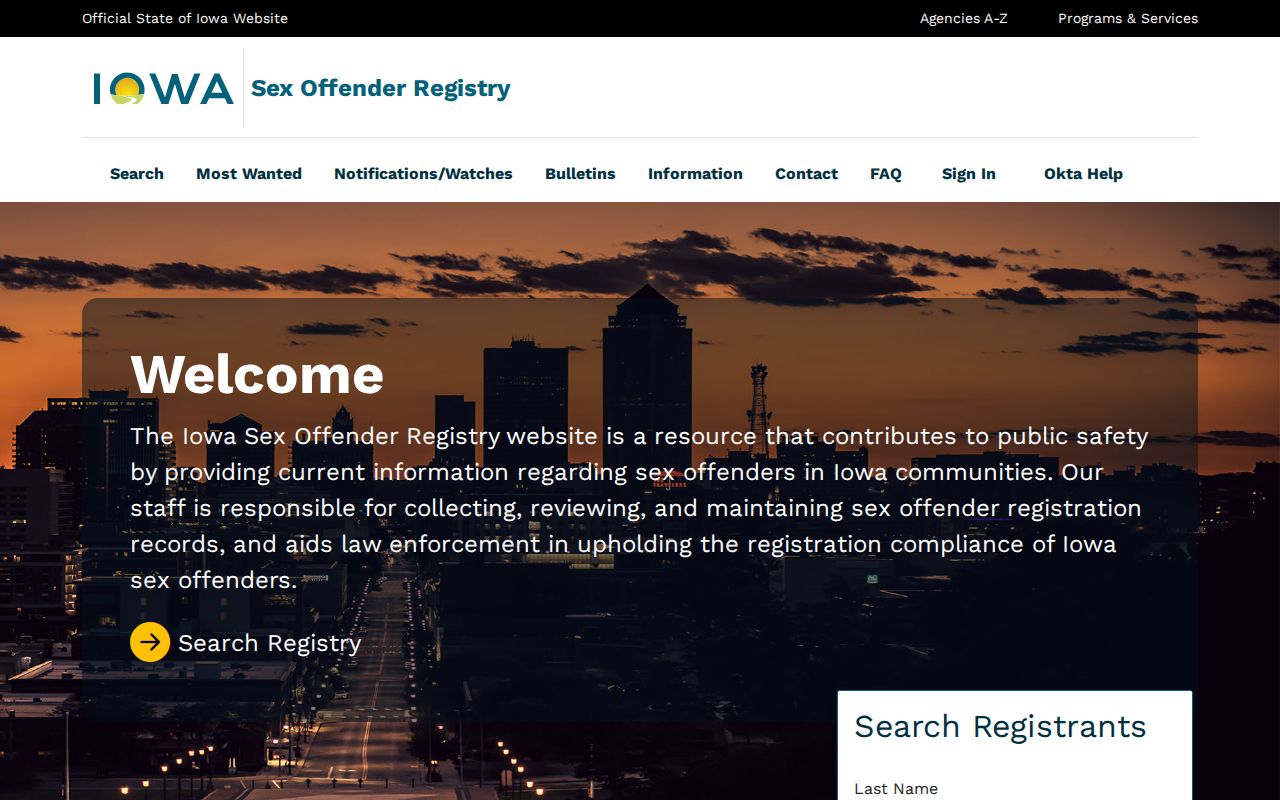
The interface keeps active-record, map, and most-wanted routes within the same state-managed registry instead of sending Sioux County residents to an unofficial list.
Iowa Sex Offender Registry Searches
For a Sioux County registry search, start with the smallest set of facts that matches the purpose. County and city filters work well for area awareness. A name query uses starts-with matching, so a partial beginning may return more than one person. Alternate-name searching can widen the results. Never assume identity from a name alone. Compare only the public profile facts needed to distinguish records, and treat map pins as orientation rather than proof of a person's location at that moment.
- Open the official registry and choose Basic, Advanced, or Map search.
- Enter a name, registry number, Sioux County, city, postal code, or address criteria. Enable alternate names when appropriate.
- Review the list or map and distinguish possible matches with public, non-sensitive profile details.
- Open the relevant profile, check its status and update information, and use official reporting channels for any concern.
The Sioux County registry search-field documentation defines the filters behind the public tools.
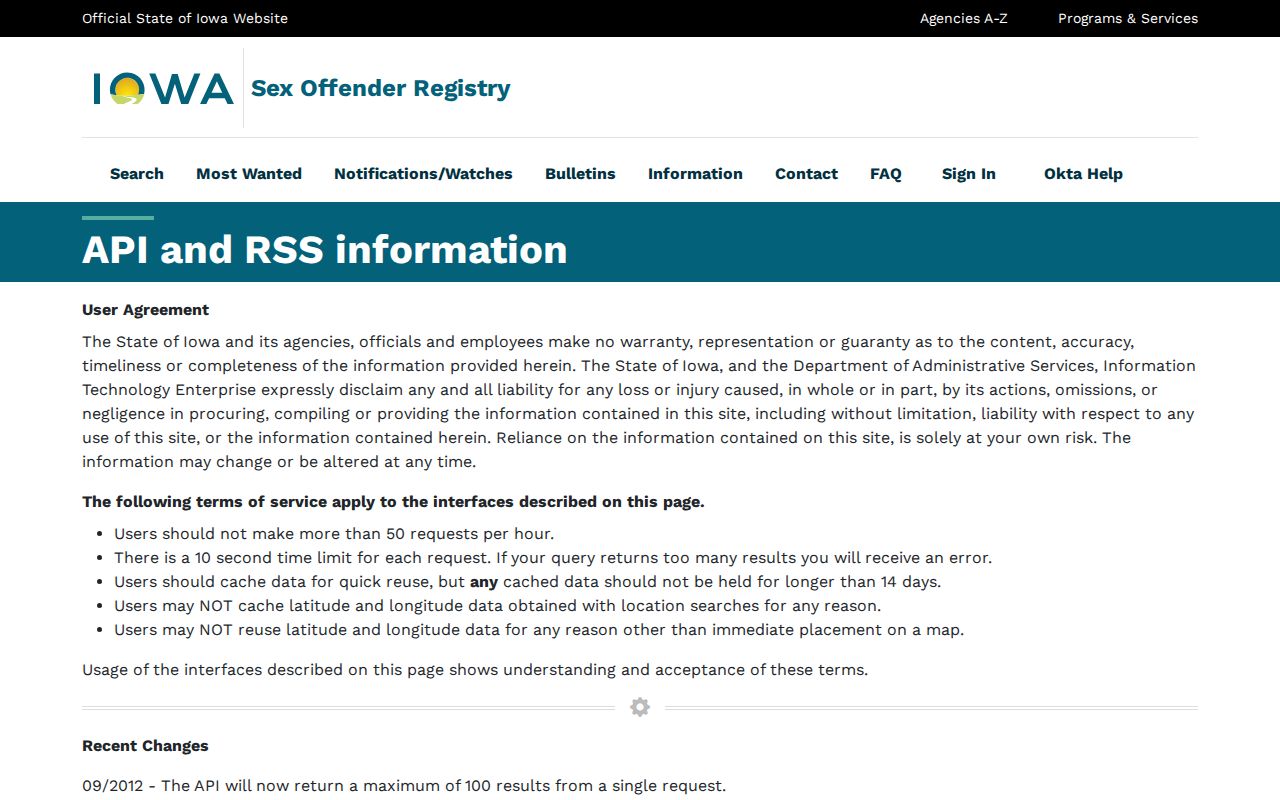
These documented Sioux County registry fields explain why nearby matches and physical-trait searches use ranges rather than exact equality.
| Field Label | Type | Required | Options or Format |
|---|---|---|---|
| Last and first name | Text | No | Starts-with matching; alternate-name option |
| ISOR/OCI number | Numeric text | No | Registry identifier |
| County, city, state | Text or ID | No | County ID and nearby-city matching supported |
| Postal code | Numeric text | No | Nearby-postal option available |
| Age, height, weight | Number | No | Age ±3 years, height ±3 inches, weight ±20 pounds |
| Address | Map-search text | For map search | Street, city, state, and postal combinations |
| Most wanted | Boolean | No | Wanted-only or all registrants |
Watch Sioux County Registry Changes
A one-time Sioux County offender lookup answers what the registry displays now. A watch serves a different need. Registered users can manage My Account and My Watches to receive email notice after registered information changes. Iowa says those notifications go out within 60 minutes of a change in the system. That promise concerns the alert after a recorded change, not the time between a real-world event and a registrant's report to the sheriff.
Choose the Sioux County area that matters and keep the notification in perspective. It can prompt a fresh look at the official profile, but it does not establish a new offense, a warrant, or a current threat. The Sioux County system is most useful for calm safety planning and awareness over time.
Note: A watch reports a registry update; it does not certify that the underlying event occurred within the prior hour.
Registry Profiles: What They Show
A public profile combines identity and registration facts submitted under Iowa law. Some fields depend on what was supplied and what chapter 692A permits the public to see. Not every profile contains every possible field. Sioux County residents should also heed the sheriff's warning that an address may be wrong when a registrant has not reported properly. An apparent error calls for an official report, not a personal visit.
| Name and aliases | Public identity names, including alternate names when supplied. |
|---|---|
| Photo and description | A photograph where available plus public physical descriptors that may change. |
| Address and geography | Registered location data, subject to reporting and processing accuracy. |
| Offense information | Historical conviction and registration facts, not an allegation of new conduct. |
| Tier | An offense-based Iowa category, not an individual risk score. |
| Status | Registration, compliance, or wanted indicators shown by the official system. |
| Other associations | Vehicle or contact-point information when Iowa law and the record make it public. |
A Sioux County profile is not a complete criminal-history report. Public appearance depends on Iowa registration duties, public-website rules, duration, jurisdiction, and current status. Someone absent from the registry may still have a court record, while a listed person may have other cases that the registry does not describe. Iowa Courts Online and the DCI record-check process answer those separate questions. The profile should therefore be used for its stated registration purpose, not stretched into a claim about every past contact with the justice system.
Sioux County Registration Office
The Sioux County sheriff's sex-offender information page identifies the sheriff as the local registering authority. Registrants must report the changes required by Iowa Code chapter 692A through that office. Staff can confirm appointment hours, required documents, and which matters require an in-person visit. No separate local appointment form or local registration fee was found in the official sources, so callers should ask rather than rely on a guessed amount.
That Sioux County local role is administrative and enforcement-focused. It does not turn a call to the sheriff into a substitute for searching the current public registry or reading the state rules that govern a specific duty.
Sioux County Sheriff's Office
4363 Ironwood Avenue
Orange City, IA 51041
712-737-2280
Call ahead for registration procedures and current appointment hours.
The jail line, 712-737-3131, appears on the sheriff's materials, but routine registration questions should begin with the main sheriff number. The county's official department directory is a fallback for verifying county contact routes. A member of the public who believes information is wrong should use the registry contact route or call local law enforcement. Do not attempt to verify an address in person.
Registration Levels and Duties in Iowa
Sioux County registry tiers are tied to Iowa offense categories and statutory rules. They are not personalized forecasts of future behavior. Iowa Code chapter 692A governs who must register, duration, verification, public availability, residency provisions, and possible modification. Offense dates, tolling, exclusions, and court orders can affect a particular obligation, so the table is a general framework rather than a profile-specific ruling.
| Iowa Tier | General Duration | Verification | Public Meaning |
|---|---|---|---|
| Tier I | Generally 10 years | Generally less frequent than higher tiers | Offense-based category |
| Tier II | Generally 25 years | Generally more frequent than Tier I | Offense-based category |
| Tier III | Generally lifetime | Most frequent of the three tiers | Offense-based category |
For Sioux County registry records, sections 692A.103 through 692A.108 contain core registration and verification rules. Section 692A.121 controls public availability. Section 692A.128 provides a modification route for some obligations under stated conditions, but it is not automatic expungement.
Sioux County Registry Residency Rules
Iowa Code §692A.113 contains residency exclusion-zone provisions and exceptions for covered registrants. It should not be reduced to a single rule that supposedly applies to every profile. The offense, its date, the person's status, and statutory exceptions may matter. For a question about a specific duty, consult the current statute and the Sioux County sheriff rather than drawing a legal conclusion from a map pin.
Sioux County registry geography also has limits. A pin reflects processed registration data. It does not prove that a person is present at that site, and a missing pin does not establish that no registrant is nearby. The map supports awareness. It does not authorize surveillance, confrontation, or entry onto private property.
Sioux County NSOPW Registry Searches
The Iowa service supplies the strongest state-specific tools for a Sioux County registry search, including advanced fields, ownership checks, map options, and watches. NSOPW supplies a cross-state layer by querying participating public registries. That national search is useful when a concern crosses the Iowa border or when someone has moved between jurisdictions.
Sioux County telephone and email ownership searches provide another Iowa-specific route. They answer whether a particular contact point is registered in the public system and should not be treated as a general identity search. As with a name result, a match should be reviewed within the official interface and handled without republication or confrontation.
The official registry search FAQ explains Iowa search behavior and the reporting channel.
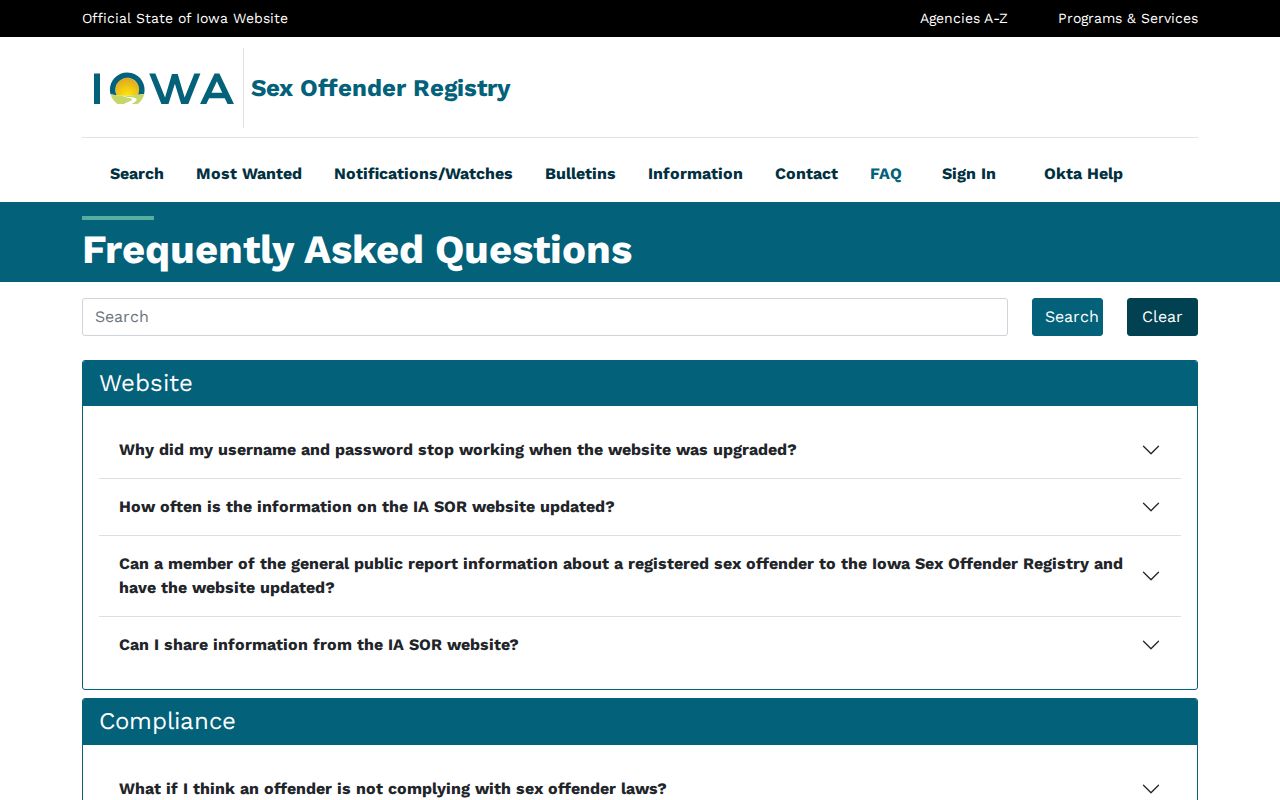
The Sioux County FAQ route helps resolve search questions without relying on a commercial people finder or an unofficial registry copy.
Using Registry Information Lawfully
Sioux County public registry information supports neighborhood awareness, family safety plans, and informed contact with law enforcement. It should be read narrowly. A listed offense is historical conviction and registration information. Ordinary active status is not the same as most-wanted status. An address issue is not proof of a new crime, and absence from the public search is not proof that a person has no past offense.
If a profile seems inaccurate or a person appears noncompliant, preserve the public details needed to explain the concern and contact the registry or Sioux County Sheriff's Office. For an occurring or imminent crime, call law enforcement at once. Do not confront the person, visit the address, publish a private identity, or organize harassment.
Misuse is not permitted: Iowa Code §692A.111 makes registration violations a crime, while chapter 692A public access does not authorize threats, harassment, vigilantism, or intimidation. Report suspected violations to law enforcement.