
Criminal Court Cases in Sioux County
Sioux County criminal court cases are matters of the Iowa District Court in Judicial District 3A. Iowa uses a unified trial court. District judges hear indictable criminal matters, including felonies under Iowa Code chapter 902 and misdemeanors under chapter 903. Magistrates and district associate judges handle assigned initial proceedings and lower-level matters. City ordinance and traffic cases also enter this state system. Sioux Center, Orange City, and Rock Valley do not operate separate municipal court search portals.
The Sioux County Clerk of District Court maintains the case file. The clerk records the charging document, appearances, motions, orders, hearings, judgment, sentence, and financial entries that are public. The Sioux County Attorney decides which indictable charges to pursue, but the clerk remains the record custodian. This division matters. An officer’s arrest report belongs to the arresting agency, while the filed criminal case belongs at the courthouse.
For a Sioux County record, use the case number whenever it is known. It is safer than a name match and leads the clerk to an exact file. When only a name is available, pair it with Sioux County, the case type, filing date, and other public context before deciding that the result concerns the right person.
Sioux County Court Clerk Copies
The authoritative copy counter is at the Sioux County Courthouse, not the jail. County information places the Clerk of District Court at 210 Central Avenue SW, Orange City, Iowa 51041. Call 712-737-2286. Posted county courthouse hours are 8:00 a.m. to 4:30 p.m. Monday through Friday. The clerk is the practical fallback for an older file, a certified copy, a listed event with no downloadable document, or a question about whether a case is confidential.
Sioux County Clerk of District Court
210 Central Avenue SW
Orange City, IA 51041
712-737-2286
Weekdays, 8:00 a.m.-4:30 p.m.
For a Sioux County copy, ask for a specific item, such as the complaint, trial information, judgment, sentencing order, or docket sheet. Give the case number and document title if possible. A certified copy bears the clerk’s authentication and serves a different purpose from a printout of the online docket. The research did not establish a current local certification or copy fee, so confirm the cost before ordering.
The official Iowa court forms catalog supplies the source view for current Judicial Branch forms used with Sioux County court matters.
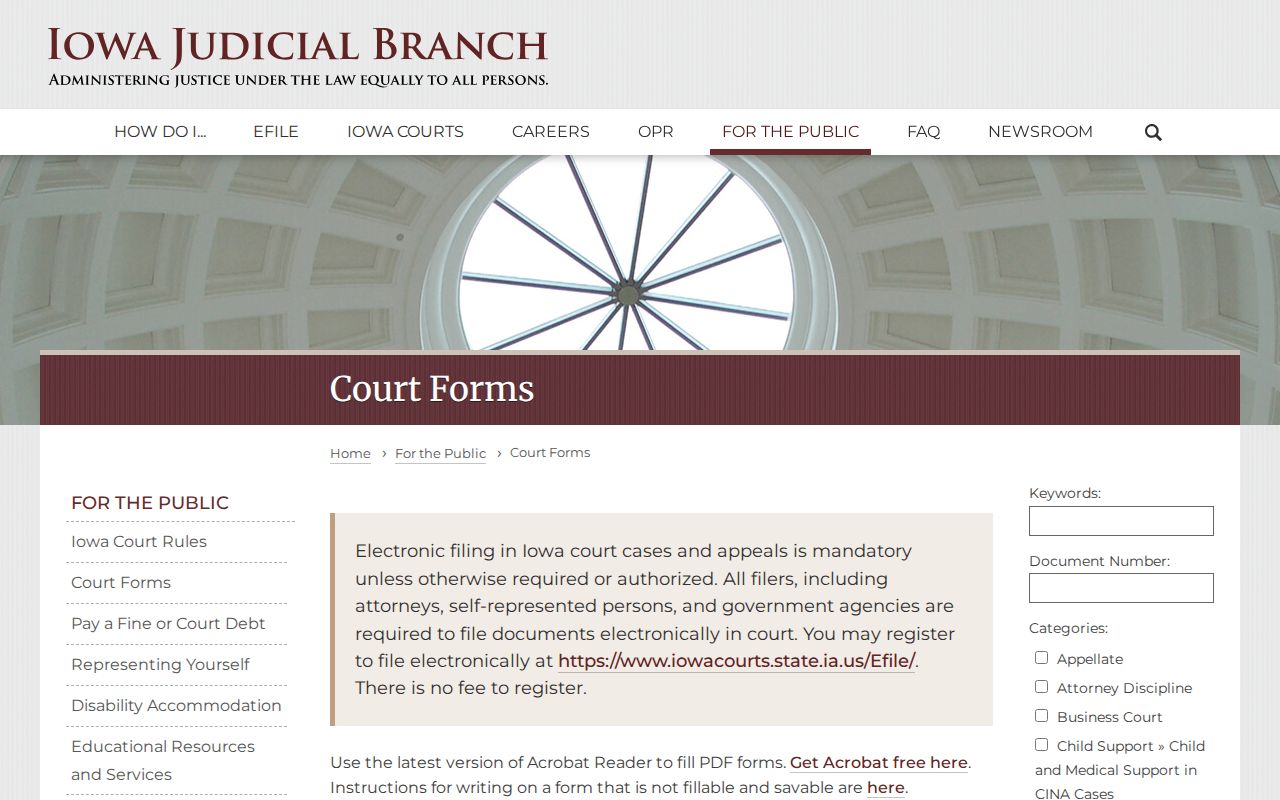
The pictured Judicial Branch forms catalog is the official place to locate current court forms, though the clerk should confirm which form fits a particular Sioux County filing.
Sioux County Case Record Searches
Begin a Sioux County case search with Iowa Courts Online. Its basic public search covers nonconfidential trial court records across Iowa. The official Iowa Courts Online guide explains its result fields. A blank result can reflect spelling, a wrong county filter, restricted access, or an older file. It does not prove that no protected record exists. The state also offers paid advanced or subscriber functions, while clerk access remains the direct route for filed documents.
- Open the trial court case search and choose the search path that matches the information available.
- Enter the exact case ID when known. Otherwise use the party name and select Sioux County.
- Narrow the result by case type or date controls where the screen offers them.
- Open the case and read each charge status, docket date, event, judgment, and financial entry in sequence.
- Call the Sioux County clerk for a missing document, an older case, or a certified copy.
| Field Label | Type | Required | Use |
|---|---|---|---|
| Search navigation | Tabs or links | Varies | Separates trial, appellate, payment, and subscriber functions |
| Case ID | Text | No | Best identifier when the exact court number is known |
| Name | Text | No | Finds parties; common names need more context |
| County | Dropdown | Search-dependent | Select Sioux for local court cases |
| Case type | Filter | Optional | Narrows criminal, traffic, civil, and other results |
| Date range | Date controls | Optional | Limits results where the selected search provides it |
The official search screen shows how Iowa routes public trial court queries.
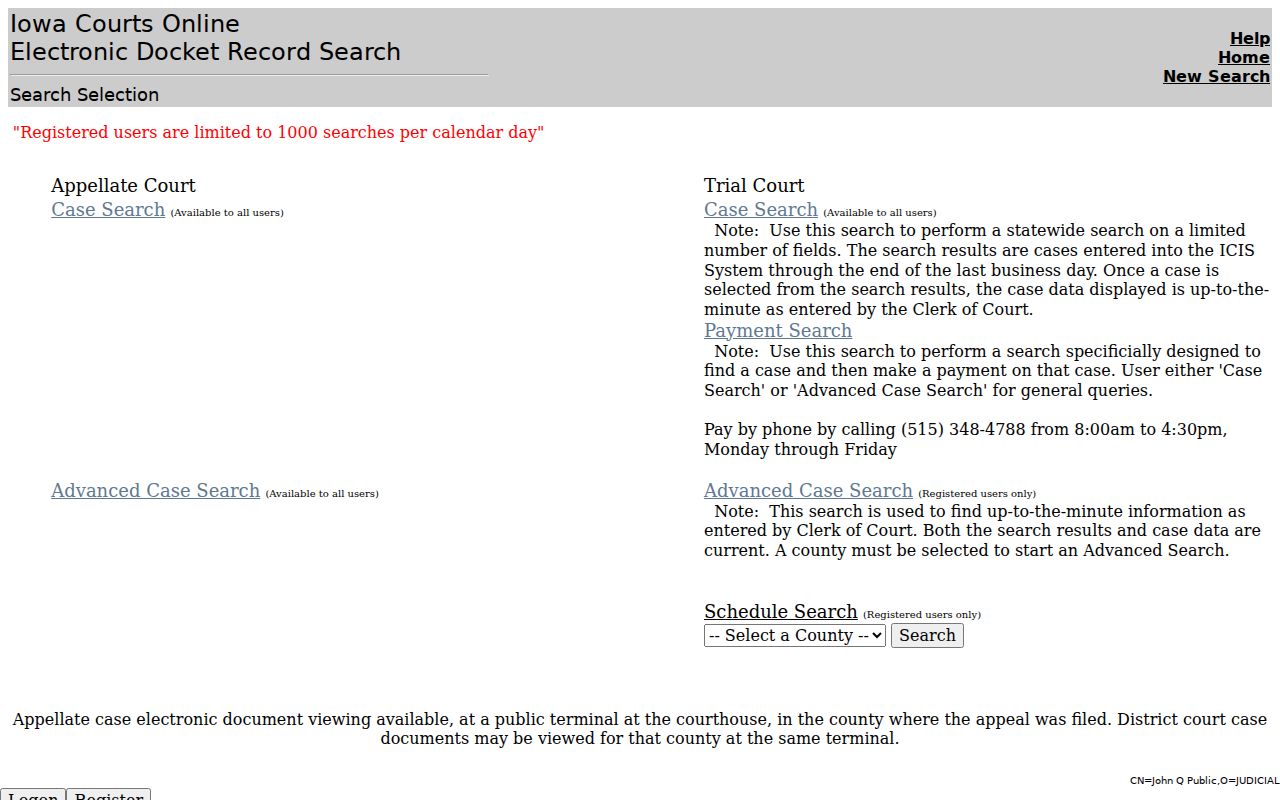
That statewide interface is Sioux County’s public court portal; there is no separate city or county docket database to search first.
Sioux County Court Dockets Without PDFs
A Sioux County docket event and its underlying document are not the same thing. Iowa Courts Online may list that a complaint, motion, order, or judgment was filed without offering a PDF. The event proves that the clerk recorded an action. It does not reveal every word in the filing. Access level, document format, age, confidentiality, or a court restriction may explain the missing link.
Write down the case ID, filing date, event name, and docket date. Then ask the Sioux County clerk for that exact document. State whether a plain or certified copy is needed. If the clerk says the item is confidential, ask whether a public redacted version exists and what court process governs access. Do not assume a technical gap means the case was sealed.
Note: A visible docket label may summarize a filing, but only the filed document supplies its full terms and context.
What a Criminal Case File Contains
A Sioux County court case file can show how the State of Iowa’s allegations changed and how the court resolved them. The public record often includes a case ID, county, case type, status, filing date, parties, attorney appearances, charge descriptions and codes, docket events, hearings, judgments, sentence entries, and financial obligations. Related cases or document links may appear when recorded and publicly available.
| Case number and court | Identifies the exact Sioux County Iowa District Court file and case type. |
|---|---|
| Charging document | Shows the complaint, trial information, or later filed counts when public. |
| Docket entries | Dates and labels for pleas, motions, hearings, orders, trial events, and filings. |
| Charge status | Tracks each filed count, including amendment, dismissal, or adjudicated result. |
| Disposition and judgment | States how the court resolved the case or individual charges. |
| Sentence and finances | May show sentence terms, court debt, and payment data where public. |
Not every case displays a judge, courtroom, bond, restitution figure, or downloadable document. Juvenile, sealed, expunged, and confidential material is excluded from ordinary public results. A delinquent court balance may enter the County Attorney's posted payment-plan process, but that plan does not clear the conviction or debt. Read field availability as a feature of that particular file, not as a promise that every Sioux County case contains the same data.
Sioux County Court Charges and Judgments
An arrest charge, a prosecutor’s trial information, and a judgment answer three different questions. The arrest label states the basis known when law enforcement took a person into custody. The Sioux County Attorney may decline, add, reduce, or amend counts after reviewing reports. The court’s judgment records the disposition of the charges actually filed. Different wording across those records is not automatically an error.
- Charge status
- The current state of one filed count, which may differ from the case’s overall status.
- Disposition
- The way a charge or case ended, such as dismissal, plea, trial judgment, or another court result.
- Docket event
- A dated entry showing that a filing, hearing, order, or other case action occurred.
- Judgment
- The court’s formal decision, which must be read apart from the initial allegation.
Compare at the charge level. A case may contain several counts with different outcomes. If a docket appears wrong, preserve the case ID and event date, then contact the clerk about docket metadata. Questions about the arrest report belong to the arresting agency. Missing statewide disposition data belongs with DCI after the court file is checked.
Criminal Case Stages in Sioux County
A court case begins when charges are filed, not merely when an arrest occurs. Iowa procedure then moves the matter through an initial appearance or arraignment, pretrial filings, a plea or trial, disposition, and sentencing when a conviction results. Motions, amended charges, continuances, probation issues, or revocation events can add branches to that path. Docket dates help place each entry in order.
Case flow: Charges Filed › Arraignment › Pretrial › Plea or Trial › Disposition › Sentencing
The case status and each charge status should be checked again after the last event. An open case may not yet have a final disposition. A judgment can also be followed by later financial, appeal, probation, or revocation entries. For the arrest and booking side of the sequence, use the contextual Sioux County arrest search.
Sioux County Federal Criminal Cases
Federal criminal cases arising in Sioux County do not appear in Iowa Courts Online. Sioux County lies in the Northern District of Iowa, so federal filings belong to the U.S. District Court and its clerk. PACER is the official federal docket gateway. It requires an account and applies the current federal fee schedule. Confirm the current charges and waiver rules on PACER before retrieving documents.
| Question | Iowa case | Federal case |
|---|---|---|
| Docket source | Iowa Courts Online | PACER |
| Local court | Sioux County Iowa District Court | Northern District of Iowa |
| Copy custodian | Sioux County Clerk of District Court | Federal district court clerk |
The official PACER gateway separates federal case access from the Iowa state docket.
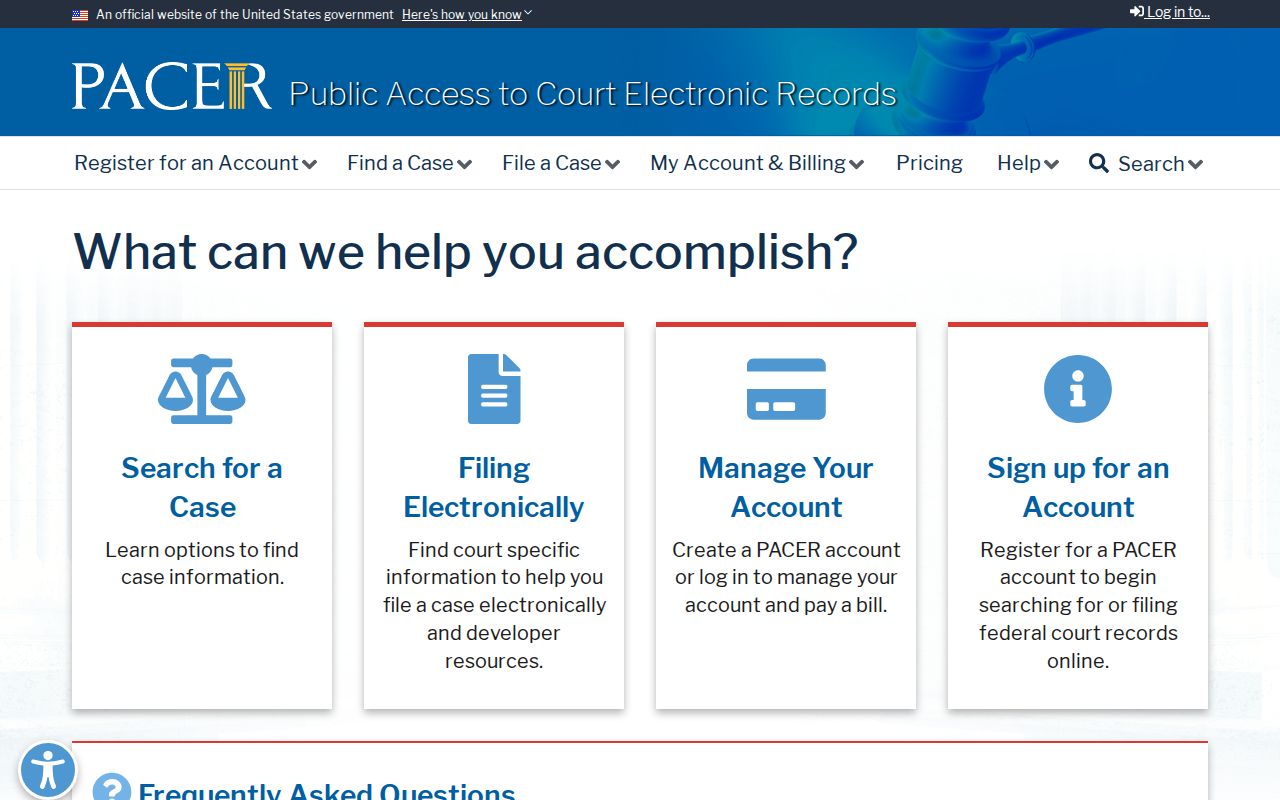
The federal interface is the correct next step for a Sioux County search when a jail entry says “federal hold” or a federal agency filed the matter.
Access Rules for Case Records
Iowa public access is broad but not absolute. Iowa Code chapter 22 gives every person a right to examine and copy public records subject to lawful exceptions. Court statutes and rules protect sealed or expunged files, confidential filings, juvenile material, and specified victim information. Online display may also be narrower than what the clerk can lawfully provide at the counter.
A blank public search can reflect confidentiality, expungement, spelling, county selection, access level, or an older offline file. It is not proof that no record exists.
Juvenile court records are generally confidential under Iowa Code section 232.147. A signed adult release does not open those files. The county’s no-contact order instructions also route courthouse record questions to the clerk. For an apparently missing public case, first verify the name and Sioux County filter, then call the clerk. If a filed record is restricted, the clerk can explain the applicable court route without disclosing protected content.
Sioux County Expunged Court Cases
Expungement can remove a qualifying case from ordinary public court access, but Iowa uses several distinct rules. Iowa Code chapter 901C covers certain dismissals or acquittals and a limited route for qualifying misdemeanor convictions. The current Iowa court forms catalog is the right starting point, followed by the Sioux County clerk for the filing process and current fee.
A completed deferred judgment creates a special distinction. The public court file may be expunged, while DCI can retain the event as discharged and non-conviction information that is released only with signed authorization. That is why a court docket and a repository history may not look identical. A person reviewing their own record should compare the exact court result with the DCI response before asking the custodian that owns the disputed field to correct it.
Note: Expungement eligibility turns on the case and current law, so court forms and clerk guidance should be checked before filing.