
Sioux County Criminal History Checks
A useful Sioux County search begins with the question, not a name box. Current custody belongs to the Sioux County Jail roster. A filed criminal charge and its outcome belong to Iowa Courts Online and the Clerk of District Court. The Sioux County sheriff can provide a narrow local check of public jail encounters. The Iowa Department of Public Safety, Division of Criminal Investigation, keeps the statewide fingerprint-backed criminal history. Each source has a clear boundary.
Gather the full name, exact date of birth, likely name variants, and any known case or incident number. Then follow the channel that holds the needed part of the Sioux County record:
- Check the official jail roster for current custody or a very recent booking. Read its update time before drawing a conclusion.
- Search Iowa Courts Online by case ID when known. Otherwise use the person's name and select Sioux County.
- Open the case detail and compare charges, events, and disposition dates. Ask the clerk for the actual complaint, order, judgment, or certified copy.
- Request the sheriff's jail-only record check for a past local booking. Supply the full name, exact birth date, photo ID, and a stamped return envelope for a mailed request.
- Order the DCI record when the question reaches beyond Sioux County or needs Iowa repository data. Use both the request and billing forms.
- Send any correction to the custodian that owns the disputed field: the police agency, sheriff, court clerk, or DCI.
Do not treat one blank result as a complete answer. A person may have a city incident report with no booking, a booking with no filed case, a court file that is protected, or a statewide event that is not public without signed authorization.
Three Sioux County Record Searches
The sheriff check, Iowa Courts Online, and DCI can return three different answers without any of them being wrong. The Sioux County Sheriff's public-records service reports public jail information for people brought to this jail. Its output is limited to arrest date, arresting agency, and charges. It excludes juvenile and traffic records and does not state the disposition.
Iowa Courts Online answers what happened after a Sioux County case was filed. DCI answers what its fingerprint-based statewide repository may lawfully release. This is why the Sioux County jail check can show an arrest while the court shows a reduced charge, dismissal, plea, or judgment. The safest reading preserves the source and date beside each fact.
| Official source | Best question | Main limit |
|---|---|---|
| Sioux County Sheriff | Was this person booked into the county jail? | No court outcome |
| Iowa Courts Online | Was a case filed, and how did it end? | Protected cases and some documents do not appear |
| Iowa DCI | What Iowa fingerprint-backed history is releasable? | Release rules and fingerprint reporting shape the result |
Official Background Checks in Iowa
Iowa Record Check Online and DCI request channels provide the official state name-and-date-of-birth check. The fee is $15 for each last name searched. DCI accepts requests online, by mail, fax, email, and in person. It does not take them by phone. Online and transmitted requests require the DCI-77 request and billing forms.
Iowa permits a member of the public to request another person's check without authorization, but the signed DCI-77 release changes what may be disclosed about a Sioux County record. Without that release, completed deferred judgments and arrests more than 18 months old with no final disposition are excluded. For an immediate in-person result, DCI limits service to the subject who presents government photo identification. Posted processing estimates vary from one to three days online and two to five business days generally, based on staffing and volume.
The official DCI page shows the state criminal-history route used for Sioux County criminal records.
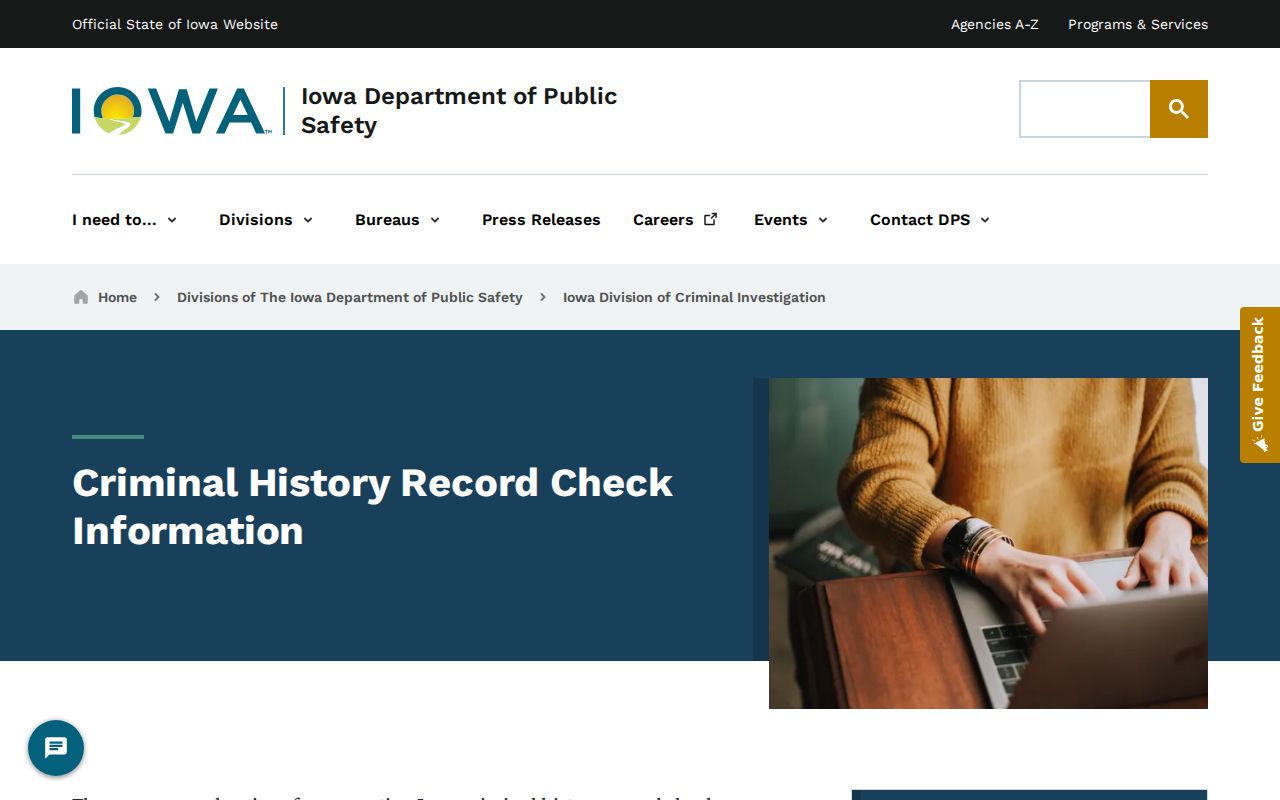
That state product is a repository check, not a Sioux County court docket or a live jail search.
Sioux County Fingerprint Record Flow
The DCI Support Operations Bureau states that every Iowa criminal-history record starts with a fingerprint card. Sioux County law enforcement creates the incident and arrest record. Jail staff create the booking file and take prints when a person enters the jail. Those prints give the state repository an identity anchor that is stronger than a name alone. Courts and clerks later report dispositions so the arrest cycle can be tied to the result.
The Sioux County record flow is: arresting agency record → Sioux County booking and fingerprints → DCI arrest cycle → Clerk of District Court disposition → DCI history update. A break in that chain matters. A Sioux County arrest without submitted prints may never appear in DCI. A delayed or unmatched disposition can leave an arrest without its result. Name-based checks can also mix up people with similar identifiers.
For a person's own federal history, the FBI electronic Identity History Summary channel requires identity details, payment, and fingerprints under current FBI instructions.

An FBI summary is distinct from both the Iowa DCI response and the Sioux County court case file.
Kinds of Criminal Records
Sioux County criminal records are products of different events and offices. The Sioux County terms are not interchangeable. An incident may produce a police report but no arrest. A booking is proof of intake, not guilt. A court judgment is the adjudicated outcome. State repository and corrections records add other layers.
- Incident report
- The responding agency's immediate facts and report about an event, which may exist without an arrest.
- Booking record
- Jail intake data, including the booking date, stated reason, charge lines, and current custody context.
- Court case file
- The filed complaint or trial information, appearances, motions, orders, plea or verdict, sentence, and financial judgment.
- DCI criminal history
- A fingerprint-associated Iowa repository record released under Iowa Code chapter 692.
- Correctional record
- State prison or community-supervision data, which does not cover every county jail stay.
- Registry record
- Public data required by Iowa sex-offender law, not a general criminal-history search.
A warrant is another distinct record. It authorizes an arrest but may be sealed, restricted, or absent from a public search until it appears in a court event or executed booking.
Ironwood Jail Records Have Limits
The sheriff's jail-only check stops at the jail door. It covers public encounters at the Sioux County Jail on Ironwood Avenue, even when a city police department made the arrest. It does not search the full files of Orange City, Sioux Center, Rock Valley, Iowa State Patrol, or another agency. A citation, summons, direct court filing, or arrest booked in another county may be absent.
The Sioux County live roster route is narrower still. It is a frequently refreshed PDF and a point-in-time custody list. The official roster can show booking date, a person's name, reason booked, and short charge descriptions. Reviewed fields did not include a booking number, birth date, bond, court date, arresting agency, release date, or photograph. A name leaving the PDF can mean release, transfer, sentence completion, movement to another agency, or a correction. The county's official arrest-search channels explain how to continue after the live roster changes.
| Sheriff product | Published fee or rule |
|---|---|
| General report production | $25 per production hour; first 30 minutes free |
| Accident report | $20; cash or check under the posted sheriff rule |
| Motor vehicle record | $20; cash or check under the posted sheriff rule |
| Jail-only record check | No clear fee found; confirm with the sheriff before requesting |
Sioux County Criminal Records: What They Contain
A complete Sioux County criminal record trace can connect identity details, an arrest date and agency, fingerprint transaction, charges, court events, disposition, sentence, and custody or supervision. No ordinary public screen promises every field. The exact Sioux County inventory depends on which official source created the record and what Iowa law permits that source to release.
| Name and identifiers | Name, date of birth, demographics, and agency or DCI identifiers where public and available. |
|---|---|
| Arrest and booking | Arrest date, arresting agency, reason booked, initial charges, holds, and intake information within release limits. |
| Filed charges | Charge number, description, Iowa code reference, filed status, and amendments shown by the court. |
| Case activity | Case number, filing date, attorneys, public docket events, hearings, motions, and orders. |
| Disposition and sentence | Dismissal, plea, verdict, judgment, sentence, and public financial obligations where recorded. |
| Custody or supervision | Jail status, state correctional placement, probation, parole, or another public supervision status in the proper system. |
DCI issues either a releasable rap sheet or a response stating that no Iowa criminal history was found. That second phrase can mean no file, no data that may be released, or only confidential juvenile information. It does not prove there was never contact with the justice system.
Iowa Courts Online for Sioux County
Iowa Courts Online is the first stop for a filed Sioux County case. Use a case ID when possible. A name search needs the Sioux County filter and careful identity checks. Basic public search is free, while some advanced or subscriber features may need an account. The statewide screen also covers traffic and civil records, so the case type matters.
| Search control | How to use it |
|---|---|
| Case ID | Use the exact court number for the most precise match. |
| Name | Check spelling and confirm identity through case context. |
| County | Select Sioux for local Iowa District Court matters. |
| Case type | Narrow criminal, traffic, civil, or other results where the screen allows. |
| Date range | Use when shown; contact the clerk for an older or unresolved file. |
A listed Sioux County docket event is not a promise that its PDF is public online. The Sioux County Courthouse houses the Clerk of District Court at 210 Central Avenue SW in Orange City. Call 712-737-2286 for certified copies, older files, or help with a Sioux County case that the portal does not resolve.
Iowa Public Access Laws
The Iowa Open Records Law creates a broad right to inspect and copy Sioux County public records, but it works alongside criminal-history dissemination rules and confidentiality statutes. Sioux County agencies may redact protected information, withhold investigative supplements, or exclude sealed and juvenile files. A request for a Sioux County police report can still seek the date, time, specific place, and immediate facts unless release would seriously harm an investigation or create a clear and present danger.
Key Iowa laws:
Iowa Code §§22.2 and 22.3 give each person a right to examine public records during customary hours and allow reasonable actual costs.
Iowa Code §22.7(5) protects investigative reports while generally preserving access to immediate facts, subject to the stated safety and investigation limits.
Iowa Code chapter 692 controls repository criminal-history release, redissemination, access, challenges, and penalties.
Iowa Code chapter 901C sets the paths and limits for qualifying expungement.
The Iowa Public Information Board provides guidance and a complaint route for chapter 22 disputes. The law does not impose one universal ten-business-day response deadline. Ask for an estimate before chargeable work begins.
Sioux County Warrant Record Chain
No verified public Sioux County active-warrant database was found in the official sources. The jail roster can show “WARRANT” after execution, but it is not a list of open warrants. A careful check therefore uses a chain of official contacts rather than a commercial name search.
Call the Sioux County Sheriff at 712-737-2280. Check Iowa Courts Online for a public case event, then call the Clerk of District Court at 712-737-2286 with a case-specific question. Contact the issuing court or agency when known. A chapter 22 request may reach releasable warrant information, while sealed warrants, juvenile process, and law-enforcement-only IOWA or NCIC data remain outside ordinary public access.
Anyone trying to resolve their own possible warrant should confirm instructions with the issuing authority and seek case-specific legal advice. Appearing based on an unofficial list can create avoidable risk.
Sioux County Criminal Record Classes
Iowa offense classes help explain the charge code shown in a Sioux County court file. They do not prove the final sentence. Class A felonies can carry life imprisonment. Class B felonies generally carry no more than 25 years, class C no more than 10 years, and class D no more than five years. Offense-specific rules, mandatory minimums, and habitual-offender provisions can alter those general ranges.
- Aggravated misdemeanor
- An Iowa misdemeanor class with a general custody ceiling of two years.
- Serious misdemeanor
- An Iowa misdemeanor class with a general custody ceiling of one year.
- Simple misdemeanor
- An Iowa misdemeanor class with a general custody ceiling of 30 days.
The arrest label is provisional. Read the filed and amended charge in Iowa Courts Online, then use the judgment for the adjudicated class and result. Fine amounts can change, so the current Iowa Code controls rather than an old schedule.
Restricted, Sealed & Expunged Records
Iowa Code chapter 901C contains more than one Sioux County expungement route. Section 901C.2 addresses qualifying acquittals and dismissals. Section 901C.3 allows a one-time application for certain misdemeanor convictions after more than eight years, no pending charges, the permitted deferred-judgment history, and full payment of court obligations. Many offenses are excluded. The current Judicial Branch forms and the Sioux County clerk are the right starting points for a local case.
A qualifying §901C.3 record becomes confidential. The clerk notifies DPS, and a maintained conviction entry is removed from DPS criminal-history files. A completed deferred judgment works differently. The public court file may be expunged, but DCI explains that it retains the event as discharged and non-conviction data, releasable only with signed authorization.
Juvenile records are generally confidential under Iowa Code §232.147. An adult release does not unlock them. A blank portal result can also reflect sealed, expunged, or otherwise protected material, so it should never be described as proof that no record exists.
Sioux County Supervision Records
Iowa probation and parole are state-administered through community-based corrections districts. Sioux County belongs to the Third Judicial District Department of Correctional Services. Sioux County supervision status can be checked through the Iowa DOC Offender Search, the sentencing or revocation docket, the district office, and public Iowa Board of Parole material. Treatment files and probation-officer notes are not a general public database.
The Iowa DOC Third District page describes the district serving Sioux County and its northwest Iowa programs.
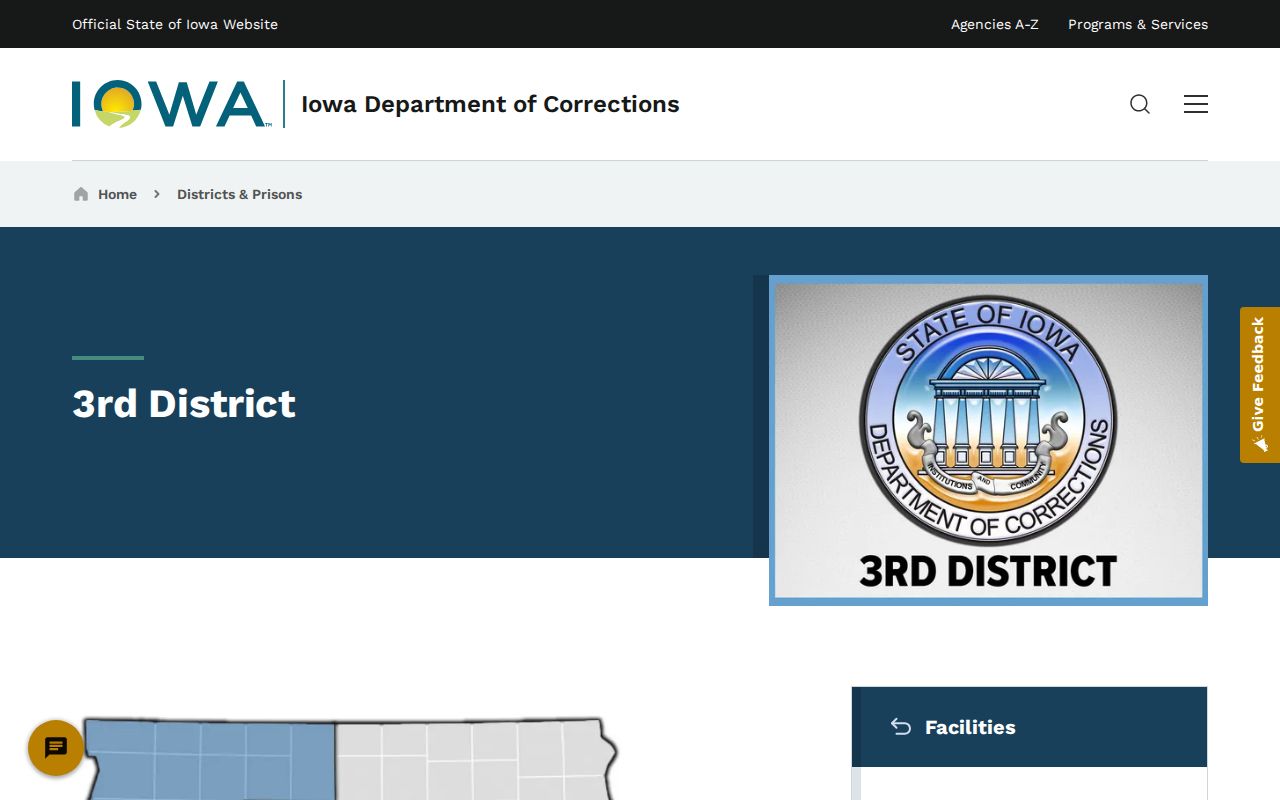
Its headquarters is at 515 Water Street in Sioux City. The district provides services that include supervision, cognitive education, and special-sentence work, while the Iowa Board of Parole makes release decisions.
Correcting Sioux County Criminal Records
First identify which system owns the bad Sioux County record field. Ask the arresting police agency to review its incident report. Ask the Sioux County sheriff to review booking or jail-check data. Ask the Clerk of District Court to address court docket metadata or a missing court document. Send repository identity, rap-sheet association, or missing-disposition questions to DCI at dcirecordchecks@dps.state.ia.us. DCI may request fingerprints to confirm identity.
Preserve the case number, incident number, booking date, roster update time, and date of the DCI check before contacting an office. A mismatch between booking and court charges is not always an error. The officer's arrest basis, the County Attorney's filed charges, later amendments, and the final judgment can all use different wording at valid stages of one matter.
Note: A generic request to the County Attorney is unlikely to correct a field owned by the sheriff, clerk, city police, or DCI.
City-by-City Criminal Records in Sioux County
City police departments keep their own incident and arrest reports, but Sioux County jail bookings and Iowa court cases move to county or state systems. Sioux Center is the largest incorporated city in the research ranking, followed by Orange City and Rock Valley. None has a verified separate municipal-court search. Their local record pages focus on the city police request route and show when to switch to the jail, clerk, or Iowa Courts Online.
Sioux Center Record Check
2020 population 8,229 · City police report, county booking, and state court routes.
Orange City Record Check
2025 estimate 6,468 · City police, courthouse, and Ironwood jail records have separate custodians.
Rock Valley Record Check
2020 population 4,059 · Start with city police, then use county booking and Iowa court sources.
Sioux County Offices Own Different Records
Orange City's compact justice geography can cause a simple but costly mistake. The courthouse holds the criminal case and County Attorney. The sheriff and jail sit at a separate Public Safety Center on Ironwood Avenue. City police departments remain the custodians of their own reports. Going to the right office matters more than going to the nearest building.
Clerk of District Court
210 Central Avenue SW
Orange City, IA 51041
712-737-2286
County hours: 8:00 a.m. to 4:30 p.m. weekdays
Sioux County Sheriff
4363 Ironwood Avenue
Orange City, IA 51041
712-737-2280
Call before visiting for a record check or fingerprint service
Sioux County Jail
4363 Ironwood Avenue, Suite 2
Orange City, IA 51041
712-737-3131
Current custody and roster questions
Iowa DCI Records Unit
215 East 7th Street
Des Moines, IA 50319
515-725-6066
In-person checks: 8:00 a.m. to 4:00 p.m. weekdays
Parking, security screening, locker, and mobile-phone rules were not found in the reviewed official sources. Call the office before a visit instead of relying on an assumed procedure.